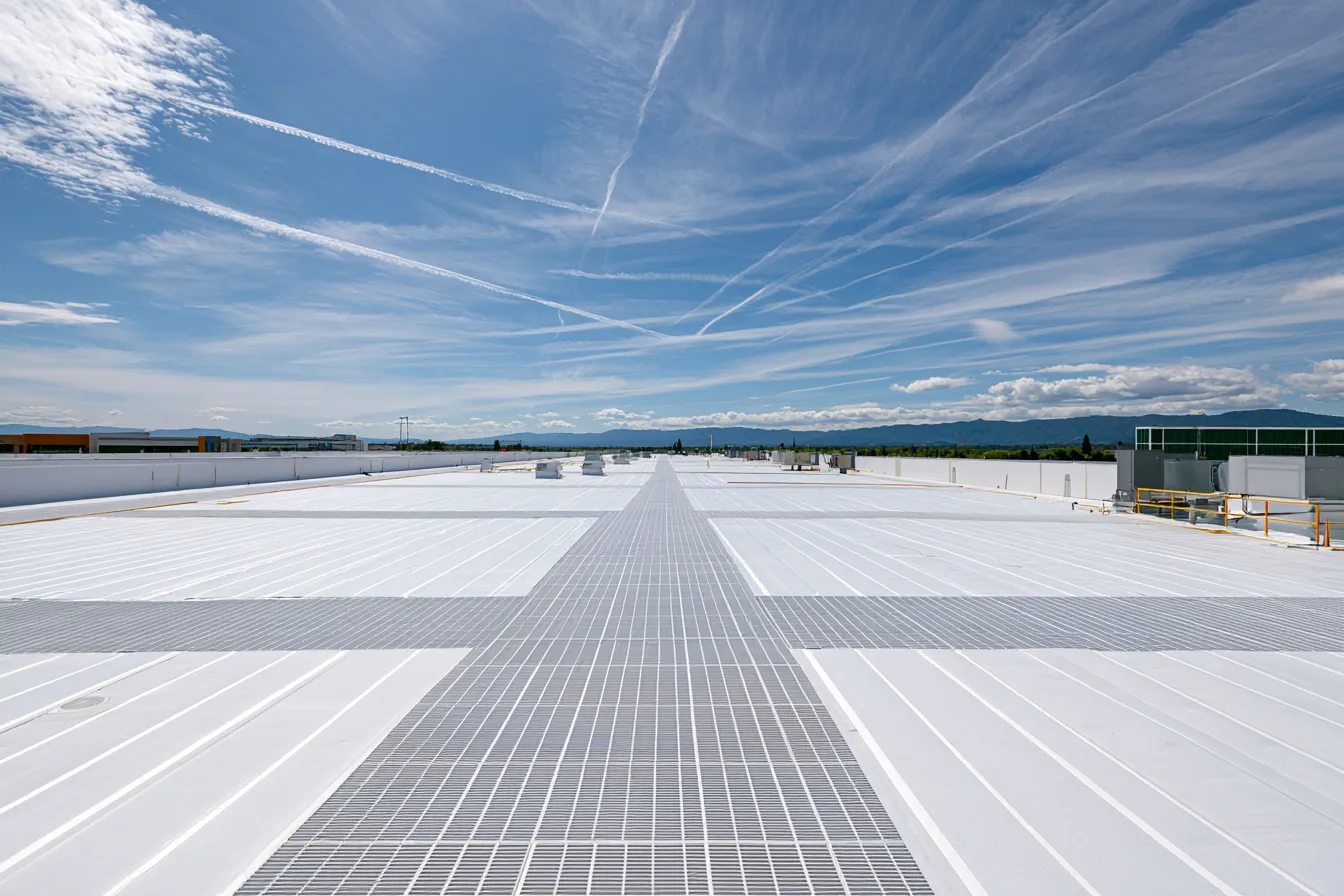
Commercial flat roof replacement in Lewisville, TX
A commercial flat roof replacement takes everything off to the deck and rebuilds the assembly new.
Age, size, and the current system say where this begins.
Commercial flat roof replacement in Lewisville, TX starts at the deck
Commercial flat roof replacement in Lewisville, TX becomes the answer when the insulation under the membrane is wet. Water in the insulation cannot be patched out, and anything laid over it is laid over a problem that keeps working, which is why a moisture survey decides this question and a walk-around cannot.
Once that finding is in, the shape of the job is simple even where the scale is not: strip to the deck, repair what is under there, and rebuild the assembly in order.
- The trigger: wet insulation, or an assembly that has simply run out
- The finding: a moisture survey, with core samples where the survey is ambiguous
- The job: tear-off to the deck, repair, then rebuild layer by layer

Tear-off, deck repair, insulation, membrane, terminations
Five stages, and the second one is the reason commercial estimates carry allowances.
- 01Tear-off
- Everything above the deck removed and disposed of, which on a large roof is a logistics exercise as much as a roofing one.
- 02Deck repair
- Corroded steel or spalled concrete gets repaired once it is visible. This is priced as an allowance because nobody can count it in advance.
- 03Insulation
- Laid to the thickness the energy code in force requires, staggered and fastened to the specified pattern.
- 04Cover board and membrane
- The cover board protects the insulation, and the membrane goes over it welded or torched by system.
- 05Terminations
- Parapets, curbs, drains, scuppers and every penetration flashed. Most of the labor lives here.
- 06Drainage check
- Water off the roof within a day and a half of rain stopping, which is what the drains and any tapered insulation exist to achieve.
All of it is the roofer's work, and the workmanship warranty on it is the roofer's to state in writing.
A phased replacement keeps the building open
Phasing is the normal shape for an occupied building. Weather sets the pace. Where the insulation is still dry, a coating or a TPO recover is the cheaper route.
Survey, cores, and a phasing plan
Where the wet areas are, what the deck is, and which sections come off in which order around the tenants.
One section at a time, dried in daily
No area is left open overnight. That single constraint drives the schedule more than crew size does.
Deck repairs as they are found
Documented and photographed against the allowance, so the extra is evidenced.
Terminations, drainage test, walk-through
Details flashed, drainage checked after rain or a flood test, then a walk with whoever signs it off.
Phasing, roof access, and what happens if it rains mid-job
The practical questions from anyone responsible for the building.
How is the work phased around tenants?
What happens if it rains mid-job?
How do you get materials up there?
Why is there a deck repair allowance?
How long does a commercial replacement take?
Building age, square footage and the current system
Three facts start a useful conversation, and a roofer can work with approximations for all three. If the current system is unknown, a core sample settles it during the survey.
Prefer to talk? Call now: (469) 240-5301
There is no obligation attached to asking what the roof needs.
Give the size and the system, and a roofer works out the allowance.